
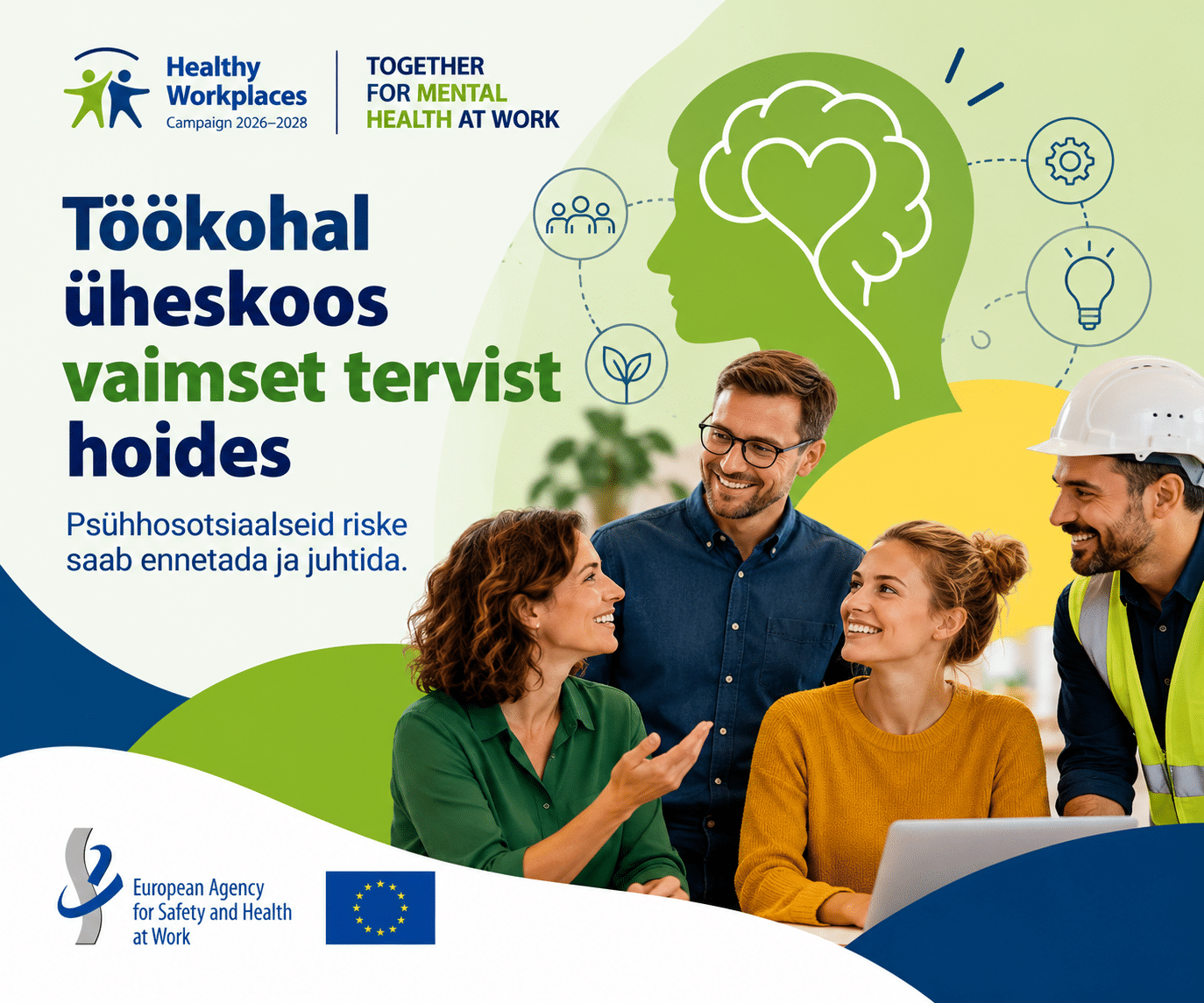
In October, the European Agency for Safety and Health at Work (EU-OSHA) launched its new 2026–2028 campaign “Together for Mental Health at Work”. The campaign focuses on psychosocial risks in the workplace – how to recognise them, prevent them and manage them more effectively.
Recent data shows that the issue affects a large share of workers across Europe. According to the OSH Pulse 2025 survey, 29% of EU workers experience stress, depression or anxiety caused or made worse by work. 37% of workers report overall fatigue.
In the ESENER 2024 survey, the most commonly reported psychosocial risk factors in companies included dealing with difficult customers, patients or pupils (56%), time pressure (43%) and poor communication or cooperation within the organisation (19%).
What can psychosocial risks look like?
Psychosocial risks are closely linked to how work is organised and managed, as well as to social relationships at work.
Risk factors may include, for example:
- excessive workload;
- conflicting demands or unclear roles;
- limited influence over how work is carried out;
- insufficient employee involvement in decisions that affect them;
- poorly managed organisational change;
- job insecurity;
- ineffective communication;
- lack of support from managers or colleagues;
- psychological or sexual harassment;
- difficult interactions with customers, patients or other people encountered at work.
At the same time, demanding or challenging work does not automatically mean psychosocial risk. Much depends on whether employees have enough support, autonomy, knowledge and opportunities to influence how their work is done.
These risks can be managed
EU-OSHA stresses that psychosocial risks should not be seen only as an individual employee’s problem. They are part of the working environment and can be assessed, prevented and managed in the same systematic way as other occupational safety and health risks.
Employee involvement also plays an important role. Workers are often best placed to identify where problems arise in everyday work and what kinds of solutions could be effective.
The EU-OSHA 2026–2028 campaign focuses on five areas: assessment and management of psychosocial risks; bullying, sexual harassment and violence; the link between physical risks and mental health; psychosocial risks in the health and social care sector; and supporting mental health at work.
Read more:
Campaign overview and focus areas:
https://healthy-workplaces.osha.europa.eu/en
Practical guidance on preventing and managing psychosocial risks:
https://healthy-workplaces.osha.europa.eu/en/about-topic/what-can-be-done
Campaign Guide with facts, examples and practical recommendations:
https://healthy-workplaces.osha.europa.eu/sites/hwc/files/hwc/publication/hwc26-28-guide_1365_EN.pdf
#EENCanHelp